
Understanding the skin type has always been the first step in skincare routine, whether it’s woman skincare routine or men skincare routine. But don’t worry you just need to know this step only one time because after knowing your skin type, you can move forward to your cleansing, moisturising and etc etc. According to dermatologists, there are five basics skin types;
- Normal Skin
- Dry Skin
- Oily Skin
- Combination Skin
- Sensitive Skin
Checking face skin type at home also has always been a dream of especially women, that’s why i am going to exactly show how to test face skin type sitting at home. Before I reveal the secret,easy method to check the skin type, you need to know that season, age, food, hormones and medicine or skincare products can affect the result.
For example, skin may become temporarily more oily in intense humid summers, while it also may feel dry in cold and dry weather. On the other hand, hormonal changes can also increase oiliness, for example it happens during puberty or menstruation. That’s why you need to keep your face completely clean while checking face skin type. So let’s get started.
How to Test Face Skin Type? 5 Easy, Simple Methods
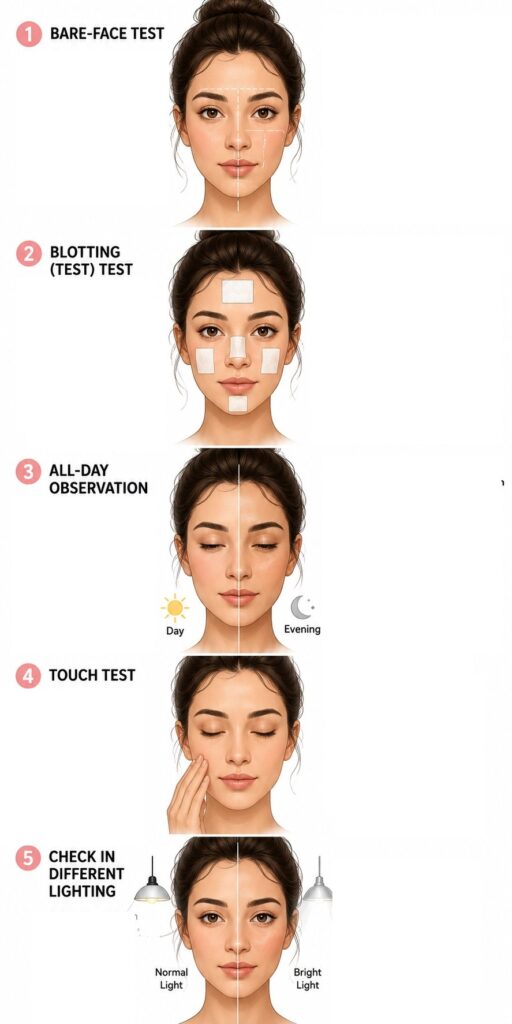
By the way, there is one MASTER method to check your face skin type, but I am going to add four other methods that will help you identify your skin type in a better way. It doesn’t matter which skin type you have, there is one simple technique for each skin type. So first I will teach you the bare-face test method and then four other techniques to make the result more visible.
Method 1: The Bare-Face Test
First, wash your face thoroughly with warm water or mild soap and pat dry with a towel. Now wait 30 minutes without any cream or lotion (this will allow the skin to return to its natural state).
Then look at your face carefully in the mirror:
→If your entire face feels shiny or oily, you have oily skin
→if your skin feels rough or tight, you have dry skin
→ if your forehead, nose and chin (T-zone) is oily, you have combination skin
→If your face feels smooth and moisturized, you have normal skin.
Method 2: Blotting (tattoo) Test
After washing your face and waiting 30 minutes (not immediately after washing), lightly press an oil-absorbing tissue or blotting paper onto different parts of your face.
Then hold the tissue up to the light and check:
→If the tissue absorbs oil from the entire face, your skin is oily.
→ if the tissue doesn’t absorb any oil at all, your skin is dry.
→if only the T-zone (forehead/nose/chin) absorbs oil, you have combination skin.
→ If each area of your face has just a slight shine, your skin is normal.
Method 3: All-Day Observation
Stick to your routine for a day and pay attention to the condition of your face throughout the day. Check in the evening:
→If your face remains oily or shiny throughout the day, it indicates oily skin.
→If only the T-zone remains oily and the rest of your face remains dry or normal, it is combination skin.
→If your face feels dry or has symptoms like itching, it is likely dry skin.
→if your skin remains soft and smooth throughout the day, it is normal skin.
Method 4: Touch Test
Lightly run your hand over your face to feel the texture of your skin.
→Normal skin usually feels smooth and supple.
→Dry skin feels rough and flaky.
→Oily skin feels greasy and slippery.
→Sensitive skin may feel itchy or burning when touched. This also gives an idea of how sensitive or tender the skin is.
Method 5: Check in Different Lightning
Look at your face in both everyday light and bright light. It may be natural or artificial. If your skin ever looks dull or red. If you feel dry and flaky in any area, this can give additional clues.
For example, dryness is more visible in bright light, while there is a slight shine in dim light. (Although this is not a traditional test, it is helpful during the checkup.)
Understanding 5 Skin Types and Its Signs
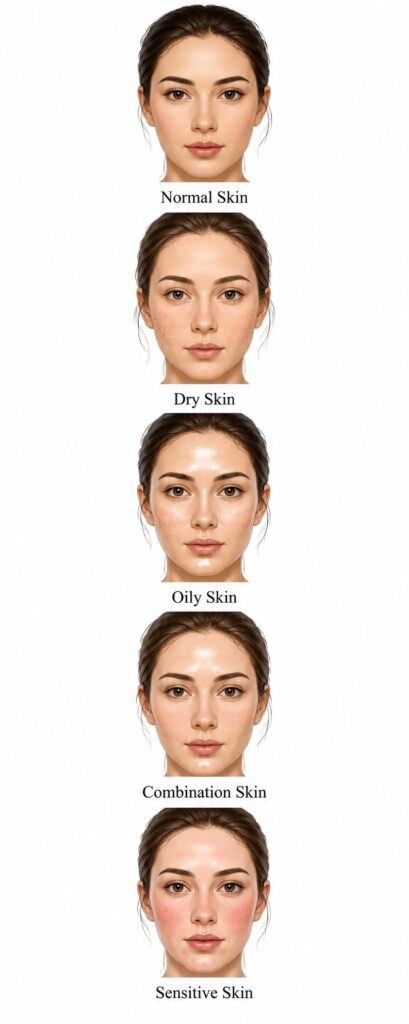
You can not understand your skin type in a better way until you do not understand all five skin types in detail. Here’s the quick but in detail breakdown of five types of skin.
Observe signs on your face also by following the above 5 methods and finalise which skin type you have, so you can follow a better skincare routine.
What Does Normal Skin Look Like?
If your skin has a normal type, both oiliness and moisture will be balanced (not too dry or too oily). The texture is smooth and the pores are small.
It is generally less prone to common problems such as itching or acne. This skin often appears healthy and tolerates most products easily.
Sometimes, due to low humidity or seasonal changes, it can appear dry or sensitive, when in fact the skin is balanced.
What Does Dry Skin Look Like?
If your skin has dry type, then oil production on your face will decrease and you will feel tight and dry skin washing the face. Your face may also look dull and flaky, fine lines become more prominent, and it feels rough to the touch.
If your skin is dry, you need to know that it requires intensive moisturizing; if it is not moisturized, it can become extremely itchy and cracked. Dry skin is often mistaken for dehydration, even though it is actually lacking in oil.
Explore more about dry skin
What Does Oily Skin Look Like?
If your skin feels oil, your forehead, nose, and chin (T-zone) of the face will be oily and shiny. They have large pores and are often prone to acne or blackheads.
Oily skin can also be caused by personal genetics or hormonal changes (such as during puberty). Sometimes, just looking at patches of oily skin leads to thinking that the entire skin is combination or sensitive, when in fact only specific areas are oily.
What Does Combination Skin Look Like?
When your face skin is oily in the T-zone, such as your forehead, nose, chin and your cheeks or sides of the face are drier or normal, it means you have combination skin because both oily and dry characteristics are found on the same face.
It is difficult to test combination skin, because each area needs to be treated separately. For example, the forehead may be acne-prone and oily, but the cheeks may be dry or normal.
And sometimes the entire face is considered oily, or it is considered dry only because of the dry areas, even though it is a combination.
What Does Sensitive Skin Look Like?
Sensitive skin reacts quickly and usually becomes red or irritated by common things or changes in weather. It can itch or burn when touched, especially when using new products or fragrances.
Sensitivity can occur with any skin type (e.g. dry-sensitive or oily-sensitive). It is also often mistaken for dry skin or allergies because the symptoms (redness, itching) can be similar to dry skin.
| Skin Type | Oil Level | Texture / Pores |
|---|---|---|
| Normal Skin | Balanced (neither dry nor oily) | Smooth texture, small pores |
| Dry Skin | Very low (lacks oil) | Rough, flaky, or tight-feeling |
| Oily Skin | High (excess oil production) | Greasy appearance, enlarged pores |
| Combination Skin | Oily in the T-zone, dry or normal on the cheeks | Mixed texture across different areas of the face |
| Sensitive Skin | Variable (may be oily, dry, or balanced) | Redness, irritation, itching, or delicate feel |
External Factors to Consider? Your Skincare Routine, Environment, and Genetics
The things you’ve described above are too strict. It doesn’t mean if you find signs of dry skin on your face, then it will be dry. There are several factors that affect your skin type.
These factors include your skin care routine, the environment where you line, and your genes from your grandpa or grandma and hormonal changes.
Let me ask one question, have you ever noticed that your skin feels perfectly balanced one day but unusually oily or dry the next? That is because your skin type is not always influenced by skincare products alone.
Here’s the breakdown of how other factors play a role in your skin type.
Your skincare routine: If you have just used any product, such as cleanser, moisturiser or any active ingredients, your skin may not behave naturally and you can find real results. That’s why test your skin type on a completely clean face without using any moisturizer, makeup or any product.
Weather In Your Area: A hot and humid day can make your normal skin looking shiny and oily, while cold or dry days of winters can make it feel tight, flaky and rough. This is why your skin may look different from season to season. Try to access your skin when it is calm and not reacting to extreme temperatures, wind, or heavy exercise.
Your Daily Diet: You may hear from your doctor that you should keep yourself hydrated for healthier skin. That happens because your daily diet plays a big role in your skin health and even its types. Just consider that when you eat foods that are high in sugar, it makes your skin oily and causes breakouts for some people.
Hormonal Changes: Things like growing up (puberty), your menstrual cycle, pregnancy, or some medications can change how oily your skin is. Some days your skin may feel extra oily, and other days it may feel normal. When your hormones are changing a lot, it’s best to wait until you can decide how your skin really looks or feels.
Genetics: You might notice how you and your mom (or dad) seem to deal with the same skin issues? That’s not just a coincidence, it’s genetics talking. If oily skin, dry patches, or sensitivity run in your family, chances are you’ve inherited some of that too. Of course, what you put on your skin and how you care for it still matters a lot. But your genes basically set the starting point, and your daily habits build on top of that.
Your Age and Medicines You’re using: According to the National Institute on Aging (NIH) as the years go by, the skin naturally produces less oil. This is one reason why many people notice increased dryness and a loss of softness as they get older. Certain medicines can also affect your skin’s hydration levels, making it feel drier, more sensitive, or even irritated.
This was detailed content on how to actually test your skin type by also understanding all factors. Recognize each thing deeply and start to test your skin type. And when you finalise your skin type, your skincare routine will also change based on your skin type. That’s why skincaretipsforalls describe every skincare tip based on your skin type.